

About Us
We are the Cluster of Excellence ctd.qmat – Complexity, Topology, and Dynamics in Quantum Matter, dedicated to exploring the quantum materials of the future. Our emblem is the donut – a symbol of the deep connection between physics and topological concepts that explain novel – topological – states of matter. They are particularly robust against external perturbation, opening the door to new and transformative technologies.
Founded as ct.qmatin 2019, we are jointly supported by two universities – Julius-Maximilians-Universität (JMU) Würzburg and Technische Universität (TU) Dresden – and funded through the German Excellence Strategy of the Federal and State Governments. In 2026, ctd.qmat was approved for a second funding period. The addition of the letter “d” marks a new phase in our research, highlighting quantum dynamics as a central theme in many-body physics.
Mission & Vision
The Cluster of Excellence ctd.qmat – Complexity, Topology, and Dynamics in Quantum Matter explores and develops novel topological quantum materials with tailor-made properties, and studies how they can be used under real-world conditions. In doing so, ctd.qmat lays the groundwork for next-generation technologies and pioneers new material concepts that reach far beyond the silicon age.
Operating jointly from Julius-Maximilians-Universität (JMU) Würzburg and Technische Universität (TU) Dresden, ctd.qmat connects two of Germany’s leading research hubs — and builds lasting partnerships with outstanding institutions across Saxony, Bavaria, and the world.
ctd.qmat unites leading scientists in condensed matter physics, photonics, materials science, chemistry, and nanoscience. It fosters scientific talent, promotes public understanding of quantum technologies, and inspires a new generation of researchers worldwide.
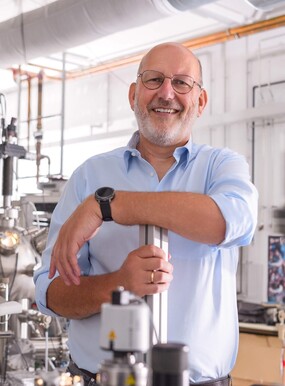
“Complexity, topology, and the dynamics of quantum processes are at the core of our research at ctd.qmat — and they are also among the most compelling themes in modern condensed-matter physics.
By linking Würzburg and Dresden, and by working closely with our external partners, we’ve succeeded in developing topological quantum materials such as manganese bismuth telluride, which display entirely new physical properties. Through patents for topological lasers and ultra-precise measurement techniques, among other advances, we’ve laid the groundwork for real-world technological applications and earned international recognition. In short, we’ve built a strong network for cutting-edge research — one that is truly greater than the sum of its parts.”
– Ralph Claessen, Institute of Physics, JMU Würzburg, Cluster Spokesperson
“With our discoveries and broad materials base, combined with state-of-the-art synthesis methods, at ctd.qmat we’re competing at the highest international level. We’ve succeeded in establishing Würzburg and Dresden as the leading German centers for topological materials physics.
We’re passionate about sharing our excitement for the quantum revolution with the public — through our award-winning mobile game “Kitty Q – A Quantum Adventure” and our quantum escape room for kids and teens, among other projects.
With the traveling exhibition RETHINKING PHYSICS, we brought the topics of diversity and equity to a global audience during the International Year of Quantum 2025. We continue to strengthen this commitment through our DEI (Diversity, Equity, and Inclusion) Committee.”
– Matthias Vojta, Institute of Theoretical Physics, TU Dresden, Cluster Spokesperson

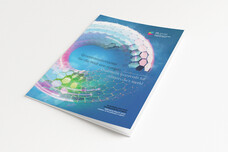
Milestones on the Road to ctd.qmat: Mid-Term Report Highlights Progress in Quantum Materials Research
Published in 2022, ctd.qmat’s first Mid-Term Report showcased selected research highlights from the initial half of its funding period. The report illustrates how the pioneering collaboration between JMU Würzburg and TU Dresden is building bridges between two of Germany’s leading centers for condensed-matter research.
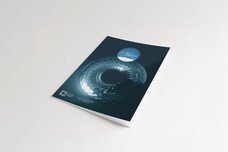
Science with a Donut Twist: Mini Report Illustrates Quantum Research Through Topology
Published in 2024, the Mini Report offered a concise, updated snapshot of the Cluster of Excellence. Its signature donut symbolizes ctd.qmat’s research vision: it represents a torus — a geometric structure whose topological properties help scientists describe and understand the unusual behavior of quantum materials.
Breakthrough research is a collaborative effort. That’s why the Würzburg–Dresden Cluster of Excellence ctd.qmat works closely with leading non-university research institutions. Together, this network advances the understanding and control of complex topological quantum materials and translates fundamental insights into future technological applications.
Below is an overview of the partner institutions involved in ctd.qmat:
Leibniz Institute for Solid State and Materials Research
A member of the Leibniz Association, IFW Dresden conducts cutting-edge in solid-state physics and materials chemistry of solids and materials. Around 500 researchers from more than 35 countries work across disciplines to investigate new functionalities in quantum and two-dimensional materials, as well as advanced materials for information processing and energy applications. As an independent research institute, IFW Dresden combines fundamental and applied research across five institutes, bringing together experimental and theoretical physics, materials chemistry, materials science, and electrical engineering to advance future key technologies.
Max Planck Institute for Chemical Physics of Solids
MPI CPfS focuses on the discovery and investigation of novel materials with unusual and technologically relevant properties. Working at the interface of chemistry and physics, researchers study how composition, atomic structure, and external influences shape the electronic, magnetic, and chemical behavior of solids. Close collaboration between synthesis, experiment, and theory has led to new quantum materials, emergent phenomena, and materials for energy conversion. The institute is part of the global Max Planck Society and brings together around 280 researchers from more than 20 countries.
Max Planck Institute for the Physics of Complex Systems
MPI PKS explores the fundamental principles governing complex systems—an interdisciplinary field that continues to evolve rapidly. Researchers develop and combine innovative theoretical approaches to address questions ranging from solid-state and molecular physics to biological systems. A hallmark of the institute is its international guest program, which offers fellowships for visiting researchers and hosts a broad program of workshops and scientific meetings. Together with its in-house research, this creates a dynamic environment for exchange, collaboration, and the development of new concepts.