
Curtain up for ctd.qmat! We’re celebrating our new name with a custom quantum groove by loop artist Konrad Kuechenmeister.
15 lecturers receive the "Prize for Good Teaching" from the Bavarian Ministry of Science. A physicist from ct.qmat at Würzburg is among them.
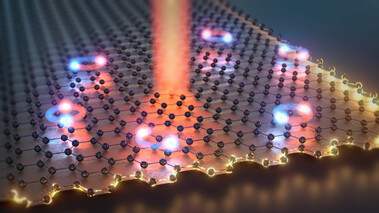
An international team of scientists collaborating within the Würzburg-Dresden Cluster of Excellence ct.qmat has achieved a breakthrough in quantum research – the first detection of excitons in a topological insulator. The findings have been published in the journal Nature Communications.
Elena Hassinger has been appointed Professor of Low-Temperature Physics of Complex Electron Systems at the Cluster of Excellence ct.qmat. The professorship has been newly established at TU Dresden. The researcher is an expert in solid-state physics at very low temperatures down to 0.01 Kelvin (-273.14 °C). She studies unusual quantum phenomena that only occur in the freezing cold, with the focus currently being on cerium rhodium arsenic (CeRh2As2) – a promising unconventional superconductor.
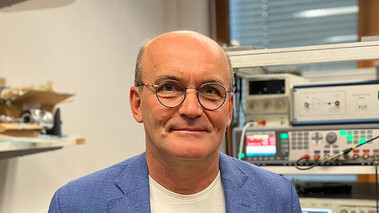
With 2.5 million euros from the European Research Council, Professor Vladimir Dyakonov will be able to pursue the development of a novel quantum sensor: The physicist was awarded an ERC Advanced Grant.
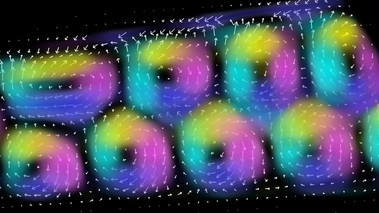
A Dresden research team led by solid-state physicist Dr. Axel Lubk has succeeded in imaging the magnetic field of tiny magnetic nanovortices – called skyrmions – in three dimensions with a resolution of seven millionths of a millimeter. This is the first time ever that this has been achieved.
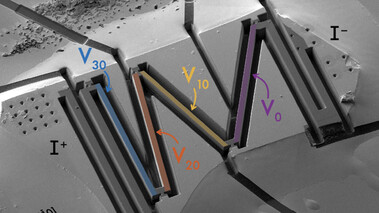
The study of ultra-pure materials still has many ways to surprise and delight! For delafossite metals it was shown that wires sculpted from the same single crystal have very different resistivities depending on the angle at which they are cut. From the fundamental physics point of view, the laws of bulk resistivity are being broken.
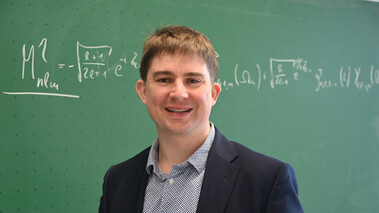
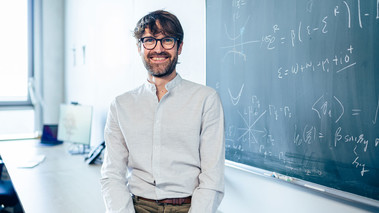
Dr. Tobias Meng is awarded the Heinz Maier-Leibnitz Prize 2022 by the Deutsche Forschungsgemeinschaft and the Federal Ministry for Education and Research. This Prize is considered Germany’s most important award for early career researchers, and is endowed with 20,000 Euros.
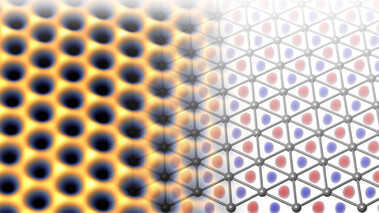
The special structure of the atomic lattice of potassium-vanadium-antimony leads to an extraordinary combination of outstanding quantum properties, which have now been demonstrated for the first time and could enable a completely new type of superconductivity. Prof. Ronny Thomale, Würzburg researcher of the Cluster of Excellence ct.qmat, predicted such quantum effects theoretically already ten years ago. The latest experimental results have been published in the journal Nature.
Prof. Claudia Felser, Director at the Max Planck Institute for Chemical Physics of Solids Dresden and principal investigator of the Cluster of Excellence ct.qmat, will be awarded the Max Born Prize 2022 for her outstanding scientific contributions to physics.
An international research team from the Cluster of Excellence ct.qmat has demonstrated a completely novel state of matter in a metal. It is created by the combination of four electrons – until now, only electron pairs were known. The results have been published in the journal Nature Physics.
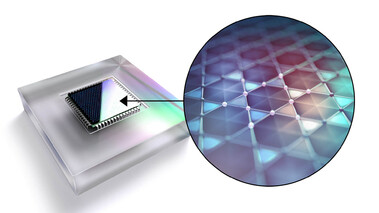
Researchers from the Cluster of Excellence ct.qmat have recently conceived and realized a new quantum material. The research results have appeared in the journal Nature Communications.
Physicists from the Würzburg–Dresden Cluster of Excellence ct.qmat have discovered a minimum distance at which electrons in wires made of quantum materials must flow in order to conduct electricity in a dissipationless manner. The research results have been published in the journal Physical Review Letters.