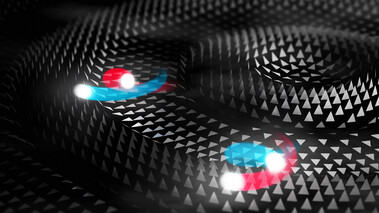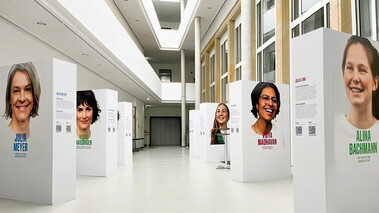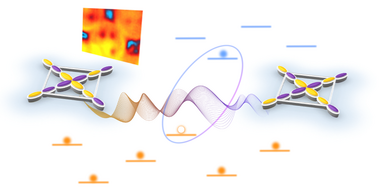

Curtain up for ctd.qmat! We’re celebrating our new name with a custom quantum groove by loop artist Konrad Kuechenmeister.

News

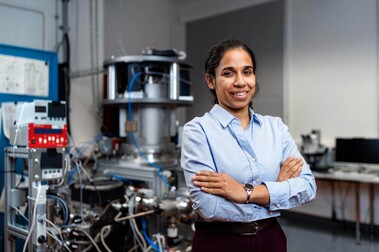
  • Aparajita Singha standing with arms crossed in a lab, surrounded by technical equipment.

    Measuring a Single Magnetic Moment. New Quantum Chair Launched in Dresden

    Aparajita Singha can measure single magnetic moments in quantum materials — a crucial foundation for future quantum technologies. She has now assumed her professorship in Nanoscale Quantum Materials at the Würzburg–Dresden Cluster of Excellence ctd.qmat and is based at TU Dresden.

  • Magentafarbene Grafik mit ctd.qmat-Logo und Stadtsilhouette als Slider für Eilmeldung.

    Cluster Renewed! 7 More Years!
    2nd Funding Period Approved by DFG

    +++ The Würzburg-Dresden Cluster of Excellence is officially heading into its second funding period starting in 2026, as just announced by the German Research Foundation (DFG). +++ Our groundbreaking research into topological quantum materials will continue – now with an exciting new focus on dynamics. To reflect this expanded scope, the cluster will relaunch under a new name in the upcoming funding phase: ctd.qmat. +++

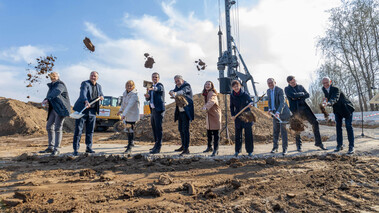
  • Gruppe von Personen mit Spaten bei einem symbolischen Spatenstich auf einem freien Gelände.

    Groundbreaking ceremony for new joint research facility of IFW Dresden and TU Dresden

     Construction is now officially underway on a new research building that will house both the Cluster of Excellence ct.qmat and the Leibniz Institute for Solid State and Materials Research Dresden – creating a world-class hub for international research into quantum materials.

  • Method Milestone for Quantum Physics: Rapid Test for Topological 2D Materials

    Topological quantum materials are hailed as a cornerstone of future technological advancements. Yet, validating their exceptional qualities has always been a lengthy business. However, researchers at the Cluster of Excellence ct.qmat have now developed an experimental technique that systematically identifies two-dimensional topological materials through a rapid test.

    Kitty Q – A Quantum Adventure: Germany’s First Quantum Physics Escape Room for Children Opens in Dresden

    +++ Cluster of Excellence ct.qmat unveils Germany’s first quantum physics-themed escape room for youngsters in Dresden +++ Kitty Q – A Quantum Adventure at Technische Sammlungen Dresden offers a gamified exploration of quantum physics +++ Michael Kretschmer, Prime Minister of the Free State of Saxony, has agreed to act as patron +++

  • Grafische Darstellung von Quasiteilchen und physikalischen Interaktionen.

    Quantum entanglement in quasiparticles: a stealth mode against disorder
    Würzburg physicists of the Cluster of Excellence ct.qmat have discovered that quantum entanglement toughens up quasiparticles against impurity scattering – even when they are subject to strong disorder.

  • Szene mit Person an einem Tisch im dunklen Raum mit orangefarbenem Spotlight.

    Cold Chips and Quantum Mysteries: Preview the Kitty Q Escape Room at SPIN2030

    Dive into the world of quantum physics with Kitty Q, the cute, half-dead cat who adores cold chips and quantum puzzles. This freaky feline is the main character and namesake of the first quantum physics-themed escape room in Germany for youngsters, currently being set up at the Dresden Museum of Science and Technology in partnership with the Dresden-Würzburg Cluster of Excellence ct.qmat. Join us for an exclusive sneak peek at the SPIN2030 Science Festival in Dresden on March 8 and 9, 2024, and be among the first to try out the cold chips puzzle table from the quantum kitchen.

  • Illustration von hexagonalen Atomanordnungen mit Lichtreflexen und Regenschirmeffekt.

    Umbrella for Atoms: The First Protective Layer for 2D Quantum Materials

    In a groundbreaking development, researchers at the Würzburg-Dresden Cluster of Excellence ct.qmat have engineered a protective film that shields quantum semiconductor layers just one atom thick from environmental influences without compromising their revolutionary quantum properties. This puts the application of these delicate atomic layers in ultrathin electronic components within realistic reach. The findings have just been published in Nature Communications.

  • A superconducting sandwich offers hope for Majorana qubits

    Dresden physicists discover the source of unique surface superconductivity, published in the journal Nature.

  • Extremely Robust & Ultra-Sensitive: Topological Quantum Device Produced

    A significant breakthrough has been achieved by quantum physicists from Dresden and Würzburg. They’ve created a semiconductor device where exceptional robustness and sensitivity are ensured by a quantum phenomenon. This topological skin effect shields the functionality of the device from external perturbations, allowing for measurements of unprecedented precision. Published in Nature Physics.

  • Pressebild-Cerh2as-Illustrationjo-Rgbandmannctqmat-16x9-I

    €2.7 million for Superconducting “Miracle”. ERC grant for Dresden quantum physicist Hassinger

    Elena Hassinger, a renowned low-temperature physicist, has been awarded €2.7 million in funding by the European Research Council. This ERC Consolidator Grant will support her pioneering work on unconventional superconductors, which could lead to a breakthrough in topological quantum computing.

  • Pressebild-Spinaron-Bild-Jubabouaziz-Ulrichpuhlfuerst-1920x1080

    Spinaron: A Rugby in a Ball Pit. New Quantum Effect Demonstrated for the First Time

    For the first time, experimental physicists from the Würzburg-Dresden Cluster of Excellence ct.qmat have demonstrated a new quantum effect aptly named the “spinaron.” This revelation challenges the long-held Kondo effect – a theoretical concept which has been considered the standard model for the interaction of magnetic materials with metals since the 1980s. These groundbreaking findings were published in the esteemed journal Nature Physics.