
Curtain up for ctd.qmat! We’re celebrating our new name with a custom quantum groove by loop artist Konrad Kuechenmeister.
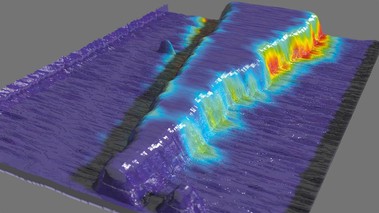
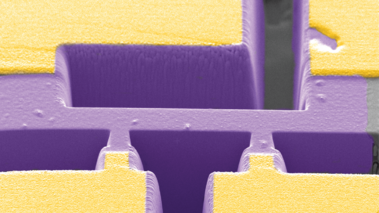
Physicists from the Würzburg–Dresden Cluster of Excellence ct.qmat have discovered a minimum distance at which electrons in wires made of quantum materials must flow in order to conduct electricity in a dissipationless manner. The research results have been published in the journal Physical Review Letters.
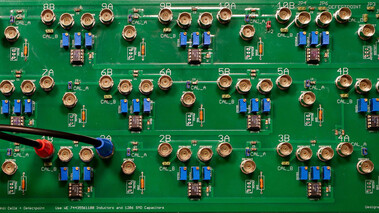
Through a recently developed experimental platform, topological matter can be realized in a fast, cost efficient, and versatile way. It was only about two years ago that researchers of the Cluster of Excellence ct.qmat realized "Topolectric Circuits" and did important pioneering work on their conceptualization for synthetic topological matter. Another breakthrough has now been achieved by the team led by Würzburg physicist Prof. Dr. Ronny Thomale.
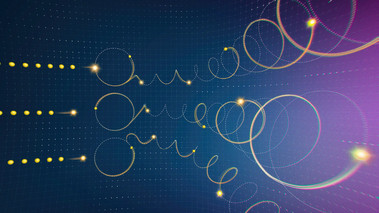
Scientists from the Cluster of Excellence ct.qmat have developed a new understanding of how electrons behave in strong magnetic fields. Their results explain measurements of electric currents in three-dimensional materials that signal a quantum Hall effect. These results have just been published in the scientific journal Nature Communications.
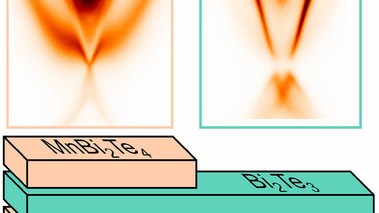
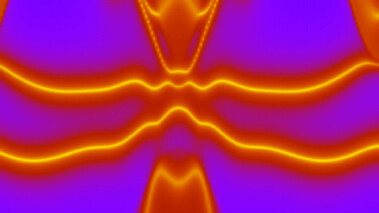
The extraordinary material manganese bismuth telluride is the first topological insulator to exhibit a number of spectacular physical effects due to its internal magnetic field. Now, researchers of the Cluster of Excellence ct.qmat found out which atomic layer has to be on the surface for this to happen. This makes it possible to better control the properties of this quantum material and brings it a little closer to everyday use. For the future, this promises a more energy-efficient technology.
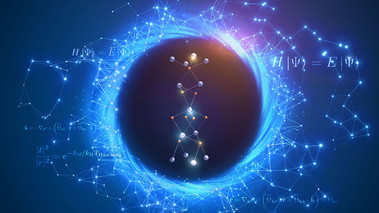
The early career research team leader Tobias Meng launches a three-year research project connecting the physics of semimetals to the theory of black holes. The German-Luxembourg research project has just received funding of roughly one million Euros.
With the help of a novel algorithm, magnetic topological compounds can now be searched for automatically. The computer method developed is considered a milestone for research into topological materials and paves the way for systematic identification of such materials, which have so far only been determined on a case-by-case basis.
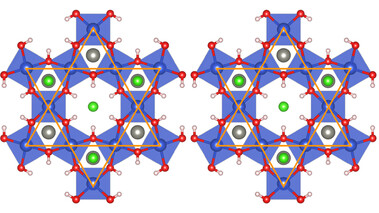
Researchers of the Cluster of Excellence ct.qmat have proposed a new quantum material in which electrons move as a viscous fluid – like a kind of quantum honey. If scientists succeed in producing the material in sufficient purity, the effect will be three times stronger than in the “miracle material” graphene.
As part of an international collaboration, the group of Andrew Mackenzie have discovered manifestations of macroscopic quantum physics in ultrapure metals. These results have just been published in Science Magazine.
Physicists of the Cluster of Excellence ct.qmat have discovered spontaneous static magnetic fields with broken time-reversal symmetry in a class of iron-based superconductors. This exceptional property calls for new theoretical models and may become important in quantum computing. The research results have recently been published in the scientific journal Nature Physics.
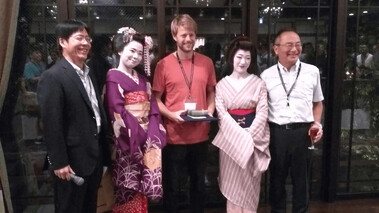
Philipp Schütz wins the poster prize at the "International Workshop on Oxide Electronics" in Kyoto, Japan.