
March 10: Closing event for the exhibition RETHINKING PHYSICS at IFW Dresden +++ March 10–12: Quantum Alliance @ DPG Spring Meeting, Dresden – Tent A, Booth 78
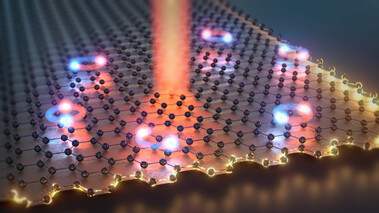
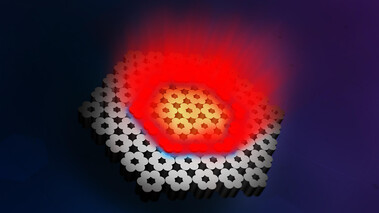
An international team of scientists collaborating within the Würzburg-Dresden Cluster of Excellence ct.qmat has achieved a breakthrough in quantum research – the first detection of excitons in a topological insulator. The findings have been published in the journal Nature Communications.
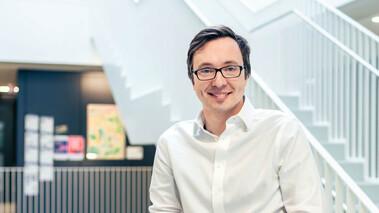
The development of a topological laser array by a research team of the Wuerzburg-Dresden Cluster of Excellence ct.qmat represents a pioneering achievement in physics. For this groundbreaking work, Sebastian Klembt from the Julius Maximilians University Wuerzburg has now been shortlisted for the prestigious “Falling Walls Science Breakthrough of the Year.”
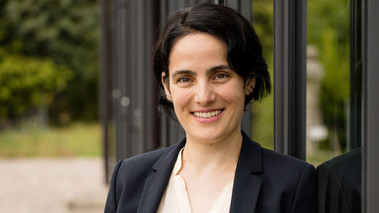
Adriana Pálffy-Buß has been appointed to the new W2 professorship for Theoretical Quantum Information and Quantum Optics at the University of Würzburg. She is an expert in the new research field of X-ray quantum optics.
Scientists of the Cluster of Excellence ct.qmat have experimentally discovered an unusual quantum phenomenon for the motion of luminescent electronic quasiparticles in atomically-thin semiconductors. The results were published in the Physical Review Letters journal.
Israeli and German researchers of the Cluster of Excellence ct.qmat have developed a way to force an array of vertical cavity lasers to act together as a single laser. The findings were presented in the journal Science.
Alexey Chernikov was appointed the new W3 professor of Ultrafast Microscopy and Photonics established by the Cluster of Excellence ct.qmat. The 38-year-old scientist pursues the goal to make ultrafast quantum mechanical quasiparticles visible in atomically thin nanocrystals.
Dresden physicist Prof. Karl Leo is honored with the European Inventor of the Year 2021 in the “Lifetime Achievement” category. Leo is one of the 25 principal investigators of the Cluster of Excellence ct.qmat, where he primarily researches semiconductor-based topological photonics.
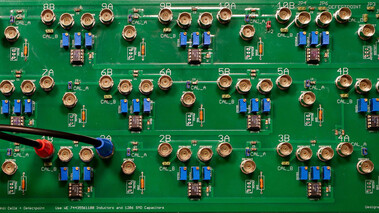
Through a recently developed experimental platform, topological matter can be realized in a fast, cost efficient, and versatile way. It was only about two years ago that researchers of the Cluster of Excellence ct.qmat realized "Topolectric Circuits" and did important pioneering work on their conceptualization for synthetic topological matter. Another breakthrough has now been achieved by the team led by Würzburg physicist Prof. Dr. Ronny Thomale.
Since a Nature article in 2018, experts have been looking forward to photonic quantum physics from Würzburg. Sebastian Klembt played a key role in the presentation of the first topological isolator made of light and matter. The scientist has been the first junior professor in the Cluster of Excellence since November 2020.
The group of Professor Ronny Thomale at the University of Würzburg, in joint collaboration with the experimental optics group of Professor Alexander Szameit in Rostock, has developed a light funnel system which might inspire new generations of hypersensitive optical detectors and sensors for future information and communication technologies. Their results have just been published in Science magazine.
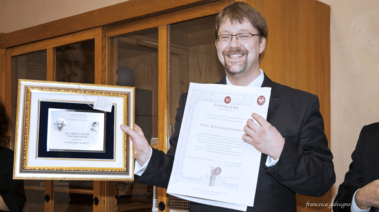
For his groundbreaking research in different areas of fundamental research our associate Alexander Szameit from Rostock University reveives the "Tomassoni Prize" of the Sapienza University Rome.