
Curtain up for ctd.qmat! We’re celebrating our new name with a custom quantum groove by loop artist Konrad Kuechenmeister.
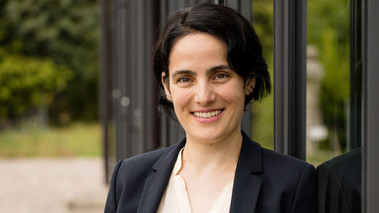
Prof. Claudia Felser, Director at the Max Planck Institute for Chemical Physics of Solids Dresden and principal investigator of the Cluster of Excellence ct.qmat, will be awarded the Max Born Prize 2022 for her outstanding scientific contributions to physics.
Ronny Thomale, a founding member of the Cluster of Excellence ct.qmat, has been awarded the Raymond and Beverly Sackler International Prize in Physics.
An international research team from the Cluster of Excellence ct.qmat has demonstrated a completely novel state of matter in a metal. It is created by the combination of four electrons – until now, only electron pairs were known. The results have been published in the journal Nature Physics.
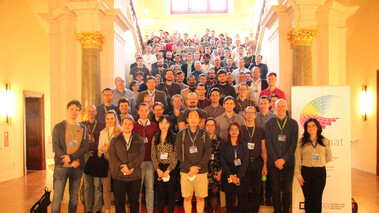
After the forced break due to corona, a little more than 80 early career researchers of the Cluster of Excellence ct.qmat – Complexity and Topology in Quantum Matter have met again in person for the first time since 2019. The meeting in Erfurt was characterized by the joy of direct exchange and scientific discussions. Immediately afterwards, the first International Autumn School took place.
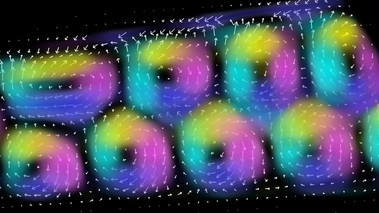
Israeli and German researchers of the Cluster of Excellence ct.qmat have developed a way to force an array of vertical cavity lasers to act together as a single laser. The findings were presented in the journal Science.
Researchers from the Cluster of Excellence ct.qmat have recently conceived and realized a new quantum material. The research results have appeared in the journal Nature Communications.
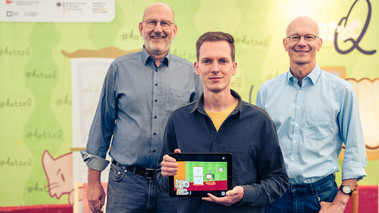
The mobile game by the Cluster of Excellence ct.qmat has been successfully tested by children, adolescents, and their parents. The app is scheduled for global release in October 2021.
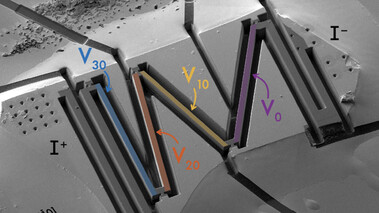
Physicists from the Würzburg–Dresden Cluster of Excellence ct.qmat have discovered a minimum distance at which electrons in wires made of quantum materials must flow in order to conduct electricity in a dissipationless manner. The research results have been published in the journal Physical Review Letters.
Through a recently developed experimental platform, topological matter can be realized in a fast, cost efficient, and versatile way. It was only about two years ago that researchers of the Cluster of Excellence ct.qmat realized "Topolectric Circuits" and did important pioneering work on their conceptualization for synthetic topological matter. Another breakthrough has now been achieved by the team led by Würzburg physicist Prof. Dr. Ronny Thomale.
Scientists from the Cluster of Excellence ct.qmat have developed a new understanding of how electrons behave in strong magnetic fields. Their results explain measurements of electric currents in three-dimensional materials that signal a quantum Hall effect. These results have just been published in the scientific journal Nature Communications.
The extraordinary material manganese bismuth telluride is the first topological insulator to exhibit a number of spectacular physical effects due to its internal magnetic field. Now, researchers of the Cluster of Excellence ct.qmat found out which atomic layer has to be on the surface for this to happen. This makes it possible to better control the properties of this quantum material and brings it a little closer to everyday use. For the future, this promises a more energy-efficient technology.
Extremely sensitive quantum sensors have great potential to revolutionize medical imaging, navigation and information technology. An international researcher team led by scientists from the Cluster of Excellence ct.qmat has made a breakthrough that could shorten the path to this goal greatly.