The Equal Opportunities in Physics Taskforce is committed to promoting diversity in science by raising the visibility of role models. The Cluster of Excellence ct.qmat is a proud partner in this initiative, which received the University of Würzburg’s 2025 Gender Equality Award.
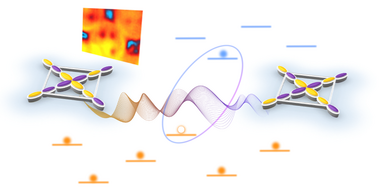
Topological quantum materials are hailed as a cornerstone of future technological advancements. Yet, validating their exceptional qualities has always been a lengthy business. However, researchers at the Cluster of Excellence ct.qmat have now developed an experimental technique that systematically identifies two-dimensional topological materials through a rapid test.
Würzburg physicists of the Cluster of Excellence ct.qmat have discovered that quantum entanglement toughens up quasiparticles against impurity scattering – even when they are subject to strong disorder.
The Würzburg-Dresden Cluster of Excellence ct.qmat hosted a German-Japanese workshop on February 26 and 27, 2024, setting the course for close collaboration between researchers from both countries. Around 70 participants from Germany and Japan convened in Würzburg to discuss their latest findings in quantum physics research. Organized by ct.qmat and supported by the Japan Science and Technology Agency (JST), the workshop delved into areas such as topology, photonics, magnetism, and the dynamics of electron correlation in solids. This exchange of ideas paved the way for joint projects in the coming years.
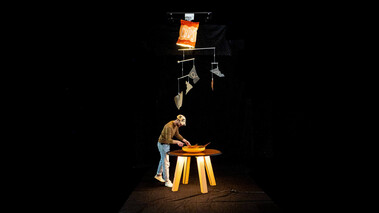
Dive into the world of quantum physics with Kitty Q, the cute, half-dead cat who adores cold chips and quantum puzzles. This freaky feline is the main character and namesake of the first quantum physics-themed escape room in Germany for youngsters, currently being set up at the Dresden Museum of Science and Technology in partnership with the Dresden-Würzburg Cluster of Excellence ct.qmat. Join us for an exclusive sneak peek at the SPIN2030 Science Festival in Dresden on March 8 and 9, 2024, and be among the first to try out the cold chips puzzle table from the quantum kitchen.
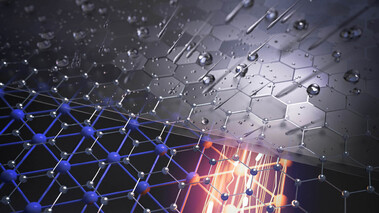
In a groundbreaking development, researchers at the Würzburg-Dresden Cluster of Excellence ct.qmat have engineered a protective film that shields quantum semiconductor layers just one atom thick from environmental influences without compromising their revolutionary quantum properties. This puts the application of these delicate atomic layers in ultrathin electronic components within realistic reach. The findings have just been published in Nature Communications.
Dresden physicists discover the source of unique surface superconductivity, published in the journal Nature.
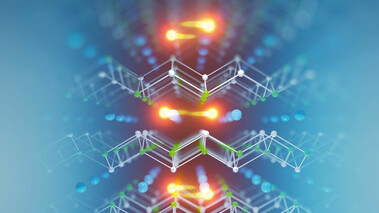
A significant breakthrough has been achieved by quantum physicists from Dresden and Würzburg. They’ve created a semiconductor device where exceptional robustness and sensitivity are ensured by a quantum phenomenon. This topological skin effect shields the functionality of the device from external perturbations, allowing for measurements of unprecedented precision. Published in Nature Physics.
Elena Hassinger, a renowned low-temperature physicist, has been awarded €2.7 million in funding by the European Research Council. This ERC Consolidator Grant will support her pioneering work on unconventional superconductors, which could lead to a breakthrough in topological quantum computing.
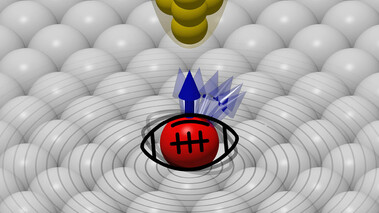
For the first time, experimental physicists from the Würzburg-Dresden Cluster of Excellence ct.qmat have demonstrated a new quantum effect aptly named the “spinaron.” This revelation challenges the long-held Kondo effect – a theoretical concept which has been considered the standard model for the interaction of magnetic materials with metals since the 1980s. These groundbreaking findings were published in the esteemed journal Nature Physics.
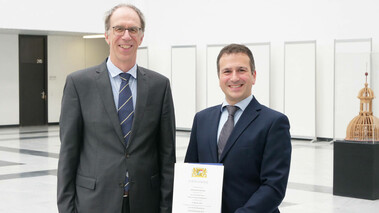
Giorgio Sangiovanni specializes in the computational analysis of quantum materials. He now heads the recently established Chair in Computational Quantum Materials at ct.qmat’s Würzburg branch, backed by €1.5 million in funding from the Bavarian State Ministry of Science and the Arts.
This summer, the Hubland Campus of the Julius-Maximilians-Universität Würzburg became a hub for female quantum physicists from around the globe. From July 31 to August 2, 2023, they gathered at the behest of the Grete Hermann Network, part of the Würzburg-Dresden Cluster of Excellence ct.qmat.