
Curtain up for ctd.qmat! We’re celebrating our new name with a custom quantum groove by loop artist Konrad Kuechenmeister.
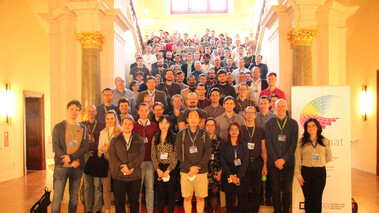
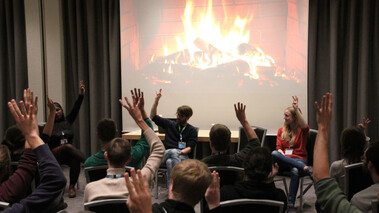
Highly motivated speakers, a buzz of voices in the foyer, and lively discussions about the presentations and the posters on display: More than 100 participants attended the first on-site Cluster Retreat – and the second one since the launch of the Cluster of Excellence ct.qmat – Complexity and Topology in Quantum Matter in 2019 – in the placid town of Merseburg from March 23 to 25, 2022. A further 30 retreat guests joined virtually.
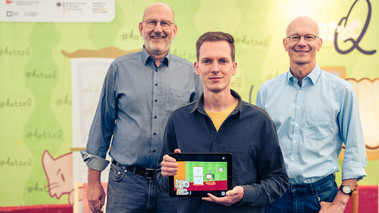
The ct.qmat Cluster of Excellence has launched a new project in collaboration with the national network of STEM schools of excellence, MINT-EC. The aim is to incorporate the latest quantum physics research results into the school curriculum as quickly as possible. Drawing on the award-winning app “Kitty Q – A Quantum Adventure,” quantum physics content will be added into school curricula as early as grade 6.
Dr. Tobias Meng is awarded the Heinz Maier-Leibnitz Prize 2022 by the Deutsche Forschungsgemeinschaft and the Federal Ministry for Education and Research. This Prize is considered Germany’s most important award for early career researchers, and is endowed with 20,000 Euros.
Scientists of the Cluster of Excellence ct.qmat have experimentally discovered an unusual quantum phenomenon for the motion of luminescent electronic quasiparticles in atomically-thin semiconductors. The results were published in the Physical Review Letters journal.
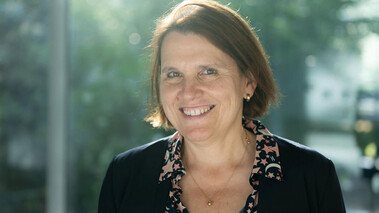
Prof. Claudia Felser, Director at the Max Planck Institute for Chemical Physics of Solids Dresden and principal investigator of the Cluster of Excellence ct.qmat, will be awarded the Max Born Prize 2022 for her outstanding scientific contributions to physics.
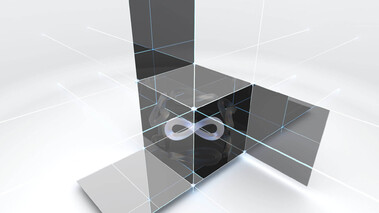
An international research team from the Cluster of Excellence ct.qmat has demonstrated a completely novel state of matter in a metal. It is created by the combination of four electrons – until now, only electron pairs were known. The results have been published in the journal Nature Physics.
After the forced break due to corona, a little more than 80 early career researchers of the Cluster of Excellence ct.qmat – Complexity and Topology in Quantum Matter have met again in person for the first time since 2019. The meeting in Erfurt was characterized by the joy of direct exchange and scientific discussions. Immediately afterwards, the first International Autumn School took place.
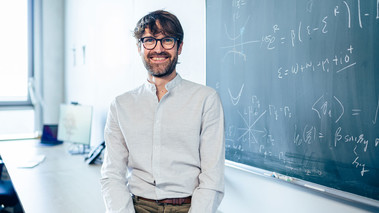
Alexey Chernikov was appointed the new W3 professor of Ultrafast Microscopy and Photonics established by the Cluster of Excellence ct.qmat. The 38-year-old scientist pursues the goal to make ultrafast quantum mechanical quasiparticles visible in atomically thin nanocrystals.
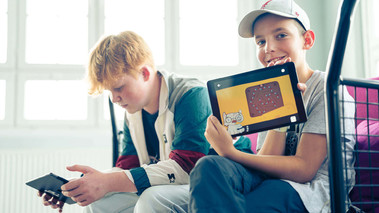
The mobile game by the Cluster of Excellence ct.qmat has been successfully tested by children, adolescents, and their parents. The app is scheduled for global release in October 2021.
Dresden physicist Prof. Karl Leo is honored with the European Inventor of the Year 2021 in the “Lifetime Achievement” category. Leo is one of the 25 principal investigators of the Cluster of Excellence ct.qmat, where he primarily researches semiconductor-based topological photonics.
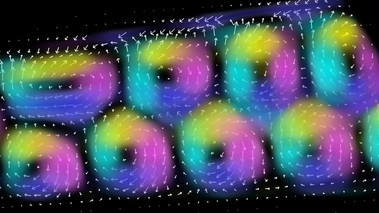
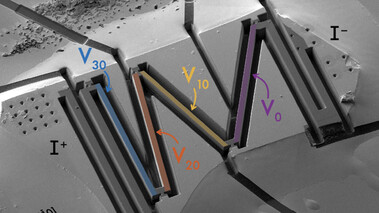
Scientists from the Cluster of Excellence ct.qmat have developed a new understanding of how electrons behave in strong magnetic fields. Their results explain measurements of electric currents in three-dimensional materials that signal a quantum Hall effect. These results have just been published in the scientific journal Nature Communications.
The extraordinary material manganese bismuth telluride is the first topological insulator to exhibit a number of spectacular physical effects due to its internal magnetic field. Now, researchers of the Cluster of Excellence ct.qmat found out which atomic layer has to be on the surface for this to happen. This makes it possible to better control the properties of this quantum material and brings it a little closer to everyday use. For the future, this promises a more energy-efficient technology.